Moonbows, also known as lunar rainbows, are distinct from typical rainbows in that they are produced by the shimmering of the moon’s beams instead of the sun.
A blood-red nighttime rainbow above Scotland around 10 p.m. Photo courtesy of Stefan.
Its production is identical to that of a sun one, with the exception of the source of light; light reflects in droplets of water in the atmosphere formed by rain or a waterfall, for instance.

They are always situated on the part of the sky that faces away from the viewer from the Moon.
Moonbows, which have been described since Aristotle’s Meteorology (about 350 BC), are far dimmer than daylight rainbows because the Moon’s surface absorbs less light.
As a result, it is far more challenging for the naked eye to distinguish colors in a moonbow since the light is typically too weak to trigger our eyes’ color sensors.
As a consequence, moonbows are typically seen as white, yet extended exposures photos do show their hues.
Rainbow produced by the moon above Kihei, Maui, Hawaii.
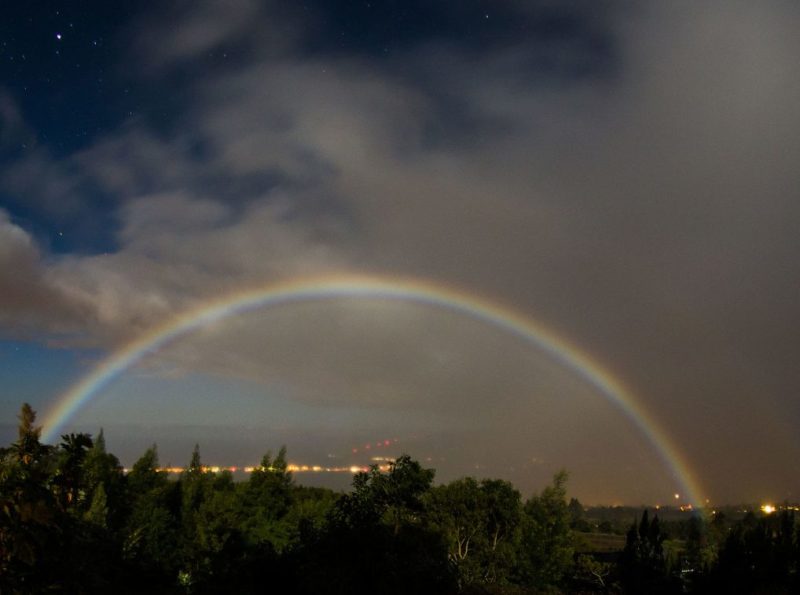
The ideal times to see moonbows are during and immediately after a full moon when the moonlight is at or very close to its highest stage and is not blocked by the sky.
It should be loww above the horizon (at a height of less than 42 degres, ideally lower) and the night must not be very black for moonbows to emerge.
However,they may only be seen a couple of hours before dawn or a couple of hours after sundown since the air is not fully black during a rising or lowering full moon.
Of addition, there must also be water vapor in the sky opposite the Moon, such as from rain or sprinkling.
They are significantly uncommon than solar rainbows due to this combination of conditions; they really happen less often than 10% of the time.
They are sometimes visible at full moon rise in the winter, when the sky is dimmer and rain is more likely to fall at high latitudes.
The clarity of the colours depends on the size of water drops in the air; the less vibrant the colours are, the tiny the water drops are.

Moonbows can also be produced by mist, frost, or spray in addition to rain.
Such bows may be found at a number of falls in the US, such as Niagara and Cumberland Falls. Another well-known attraction on the border of Zambia and Zimbabwe is Victoria ones.
How are they recognized? As mentioned previously, they may only be seen against a black sky towards the end of the night’s dusk or just before daybreak for around 3 days around a full moon.
Summertime moons, when it takes longer low in the sky, are the greatest time to catch it in mid – latitudes.
Moonbows in other sesons could only endure for one hour.
Keep an eye out for a faint one during showery weather when the Moon is low and brilliant.
The likelihood of seeing many colors is low, but if you set a camera on a tripod, you can easily catch the hues.
Best luck! Share this incredible story with your freinds and family to make their day and filll it with love and light.